
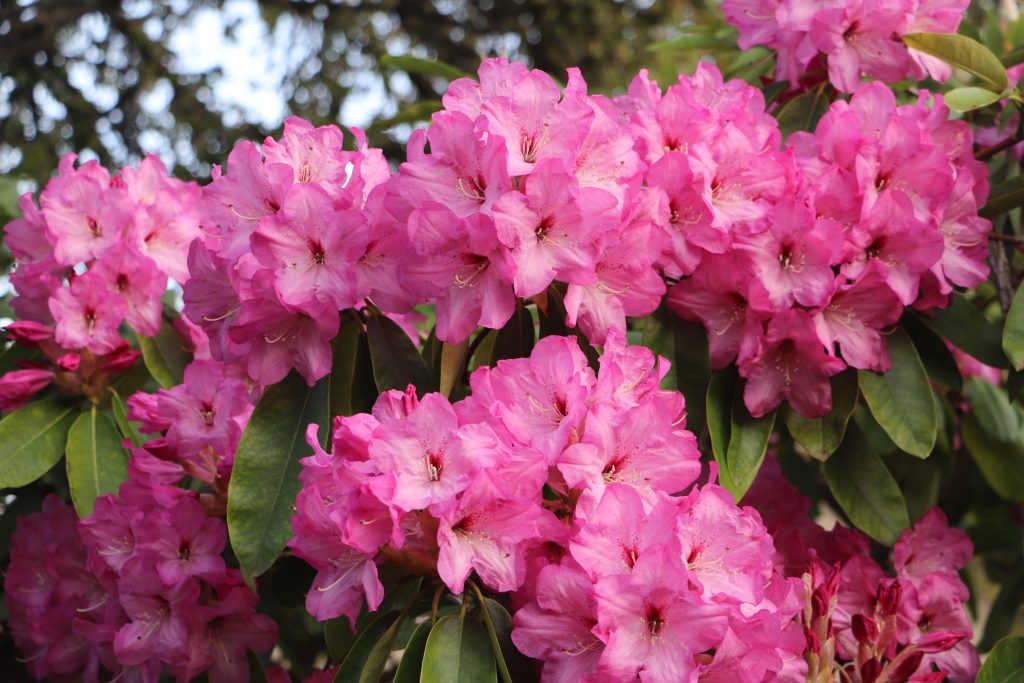
 It’s time to begin pruning your rhododendrons and azaleas, and to make a plan to finish pruning them, if you have a lot of them like I do.
For some reason, the people I bought my house from planted 40 rhododendrons and 12 azaleas. Did they like them? Were they trying to make their yard look good for the sale?
When I moved in during the 1990s, the rhododendrons were small, like when you buy them in pots at the garden or hardware store.
About 15 years later, they were giants.
Fortunately, I met Deane Rimerman, a forester who loves to prune, at a coffee shop when we were working on our blogs. In addition to pruning my trees, Deane helps me keep the rhododendrons under control because here in the Pacific Northwest, they love it and would grow to 20 feet or more if I let them.
Here are my tips for pruning rhododendrons:
Start early. Prune just after blooming or when buds start to become active. Rhododendrons don’t like to be pruned in hot weather. In my experience, they droop if pruned when it’s hot. I like to have mine pruned by June 30.
Remove dead, dying, or diseased branches any time. Cut back flush with the main branch or trunk. Removing dead branches will make your rhododendrons healthier. It increases the amount of sunlight and air that can circulate through the plant. More sunshine means more photosynthesis and growth. It also allow the plants to more quickly seal wounds to avoid unnecessary decay.
Make spaces between your rhododendrons, if you have large ones that are growing together. You need to be able to walk around them to take care of them.
Prune the plants so that they don’t touch the house or fence. Insects can crawl from the plants to your house or fence and, since plants get wet from rain and watering, mold can develop on the house or fence.
Trim off any branches that are dragging on the ground. Insects can crawl up the branches into the plant. In addition, the plants look better when these branches are removed.
Shape your plants and remove branches that are crisscrossing each other. You can encourage your rhododendron to grow in a certain direction or area by cutting back the parts you want to be smaller, and leaving the parts you want to be larger. This is helpful when your rhododendron is near your house, or when you are trying to keep a more uniformed look. Rhododendrons will only conform to a shape to a certain extent. They have broad leaves and longer branches, so they may not look completely uniform. A friend of mine tries for the fountain shape when pruning her rhododendrons. Mine sometimes have an oval shape because I have so many and I’m pruning them so I can walk between them. Deane’s often look like trees, with a rounded top and bare trunk.
Get out your ladder, if your rhododendrons are getting too large. Try to opened them up at the top so sunlight can get down through the plant. I like my rhododendrons nice and thick at the top, but that doesn’t work well because they develop diseases. In addition, there are more small dead branches if the sunlight can’t get in.
Cut branches off just before the last leaves on the branch or just before a tiny green growth bud.
Deadhead or remove the old, dying blossoms as you prune. Be careful not to remove the emerging new growth under them.
Don’t worry if you’re cutting back your plants severely. However, it will be a year before the plant has much foliage and two or more years before they have flowers.
And, here are some tips for pruning azaleas:
Prune in the spring. The best time to prune azaleas is soon after the flowering period in the spring. Spring-flowering azaleas form their blossom buds for the next year during the summer, so avoid pruning them after July 1.
Clean your pruners. Clean them before you begin, then clean them after you prune each plant. You don’t want to spread diseases from one azalea to another.
Shape the plants. Prune back leggy branches that have grown beyond the main body of the plant. When a branch is thinned, the complete removal of a branch back to another branch, it opens up the canopy, improves air flow, and helps minimize diseases. Don’t shear an azalea unless you want to create a formal hedge, espalier (grown against a flat surface, frame, or trellis), or topiary plant. Shearing destroys the natural form of the plant.
Cut the plants back if they get too large. If this happens, cut back the large plants to 6 to 12 inches above the ground shortly after they bloom. When new growth buds appear on the stem, the new stems and leaves will grow very fast. Pinch out any long, unbranched shoots that develop to force a branch system.
Remove dead wood. This can be done throughout the year.
Best wishes with your rhododendron and azalea pruning. Enjoy the beautiful days of spring and summer in your yard.



You might want to include how or with what to clean your pruners when pruning rhododendrons. With hydrogen peroxide? A dilute chlorine/bleach solution? Hot water & soap? Or just wipe the blades w/a clean cloth?
Good point. With hydrogen peroxide, or with a dilute chlorine/bleach solution if the strong bleach doesn’t bother you. Hot water and soap or wipe the blades with a clean cloth would help, too, but not as much.