
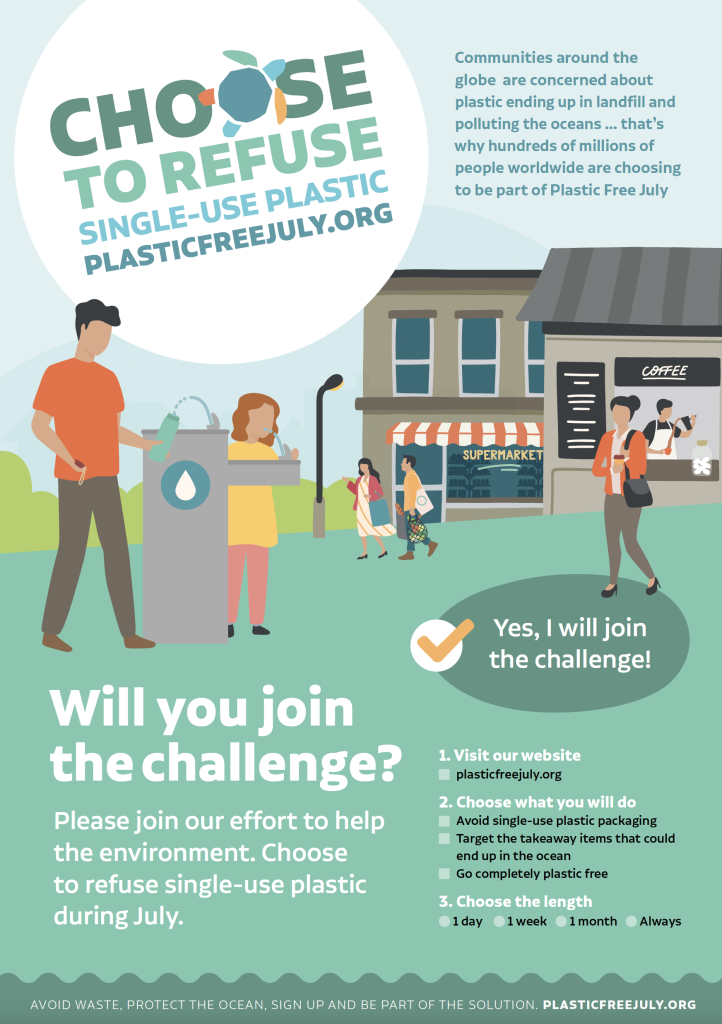
About a week ago, I received an email about Plastic Free July, a global effort to help people reduce single-use plastic waste every day at home, work, school, and at local stores.
The organization sponsoring the action, the Plastic Free Foundation, asks people to choose to:
- Refuse single-use cups.
- Refuse single-use plastic bottles.
- Refuse plastic food wrap.
- Refuse plastic bags.
- Make a plastic free pledge.
This year’s Plastic Free July campaign focuses on small changes each of person can make to reduce plastic waste under the slogan “Small steps, big difference.” Each year millions people from more 190 countries worldwide join together to refuse single-use plastic.
With 174 million participants globally in 2024, Plastic Free July is now the largest waste avoidance campaign on the planet, according to the Plastic Free Foundation’s 2024 annual report.
About 22 billion pounds of household waste has been avoided by participants over the last five years, according to the organization.
Single-use cups, plastic drink bottles, and plastic food wrap are the top three items single-use plastic items that people commonly use each day that can be easily replaced by:
- Refilling reusable water bottles from the tap.
- Bringing a reusable cup or sitting and enjoy a real cup.
- Switching from plastic wrap to reusable containers or wax wraps.
“At the Plastic Free Foundation, our vision is clear: “a world without plastic waste,” Geoff Donohue, chair of the Plastic Free Foundation, said in the group’s 2024 annual report. “We are committed to supporting a global network of changemakers, fostering community engagement, and shifting social norms to drive the systemic change required by business and government.”



Oregon has banned some single use plastics & that’s greatly reduced the number of plastic bags that end up along roadsides, Oregon’s beaches and in the ocean. Doesn’t do anything to decrease the number of children’s toys made out of plastics or that it’s not possible in Oregon (maybe the world?) to recycle most plastic containers. I mostly glass containers at home–but they have plastic lids. That plastic is meant to be far more durable the plastic bags, etc but it’s still plastic, usually a petroleum product.
That I now see so many people using (sometimes plastic coated) reusable bags is a step in the right direction–I have a good memory of a checker at a local supermarket explaining in detail to a customer who’d complained about having to pay for paper bags (because she didn’t have any reusable bags w/her) why discontinuing plastic bags was such a good idea. After the customer left, I congratulated the checker for taking the time to provide a clear explanation.
I’ve been using glass jars with metal lids, canning jars, to store food in at home for decades. When plastic food storage containers first came out, the FDA didn’t say they were safe. It said as far as it knew, they were safe. Now we’re finding out that plastic particles are ubiquitous in people’s bodies and in the environment. What we don’t know yet is what harm they are causing to people, animals, and the planet.
I had no idea about this and glad to know it.
Excellent idea. Change comes about in small steps that start to add up.