
When I was finally able to watch “Food Inc.,” the Academy Award-nominated documentary, I expected to see images of animals being raised in awful conditions, to see “factory farming,” and to hear recommendations to eat local, organic food.
However, 10 items in the movie stunned me. “Food Inc.” reported the following:
1. Factory farms. Farmers have no say in how chickens are raised, because they are under contract to huge companies such Tyson. Enormous sheds with as many as 20,000 chickens are breeding grounds for disease and bacterial growth. Fast food companies have engineered chickens with big breasts that can be slaughtered in 49 days.
2. Corporate control. A few companies control the food supply. In the 1970s, there were thousands of slaughter houses. Now there are 13. A hamburger has meat in it from thousands of cattle. This makes it easier for contamination to become widespread and more difficult to track the source.
3. Big government subsidies. The federal government heavily subsidizes corn, soybeans, and wheat. Corn can be made into obscure products, such as high fructose corn syrup, or fed to animals or fish. Food is engineered using these crops. Ninety percent of foods contain high fructose corn syrup or soy beans or both. Consumers eat 200 pounds of corn a year.
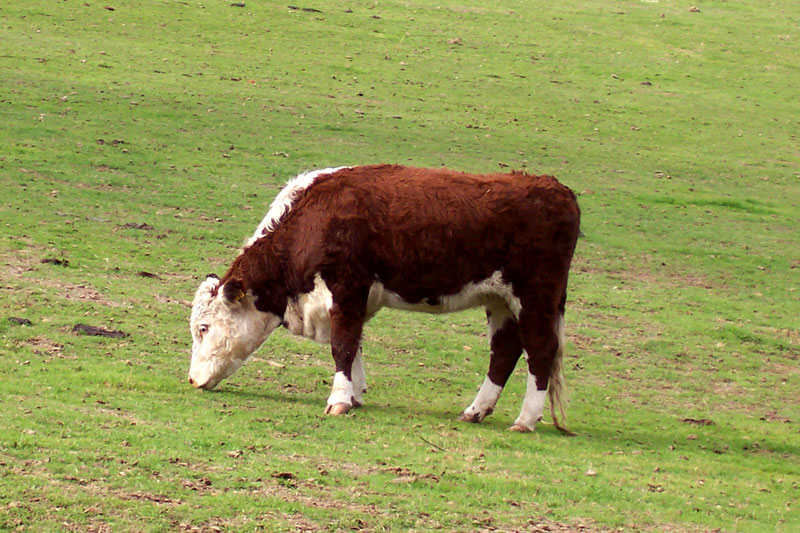
4. Wrong feed. Cattle are fed corn because it’s cheap. Grass is their normal diet. When cattle are grass fed, their digestive systems are more acidic and resistant to E. coli. When cattle stand ankle deep in their manure, their hides become caked with it. That’s one way manure and harmful bacteria get in the meat.
5. Enforcement issues. Due to lawsuits by agribusiness, the courts have ruled that the U.S. Department of Agriculture doesn’t have the authority to shut down plants that don’t meet food standards. The family of a 2-year-old boy who died in 2001 after eating a contaminated hamburger has been working to get a law passed to give the USDA that authority. A bill has passed the House of Representatives, and S. 510 is pending in the Senate.
6. Heavy chemical use. Rather than feed cattle grass to reduce contamination, America’s farm factory model relies on chemicals. Ammonia and ammonium hydroxide are used as a “processing tool” to clean equipment that produces hamburger meat filler. The filler is used in 70 percent of the hamburger produced in the country.
7. Obesity and cheap food. The biggest predictor of obesity in America is income level. Cheap engineered food made from subsidized corn, soybeans, and wheat is loaded with salt, fat, and sugar, items people crave.
8. Dangerous, unsanitary slaughterhouses. Conditions in slaughterhouses are dangerous for workers as plants get larger and larger and lines speed up. Employees covered with blood, feces, and urine can become infected. Wages have been cut and benefits eliminated. Immigrants, many illegal, can’t complain about the conditions.
9. Food crops owned. Monsanto, a company that genetically manufactures seeds, owns entire food crops. In 1998, 2 percent of the soy bean crop grown in the U.S. was from genetically manufactured or GM seeds. In 2008, 90 percent of soy beans were grown from them. Monsanto has a patent on the seeds, and the company doesn’t allow farmers to collect seeds and plant them. It’s taking farmers to court who save seeds. Even farmers who don’t plant GM seeds, but the seeds blow onto their farms and grow, are accountable. Seed cleaners are being put out of business. Supreme Court Justice Clarence Thomas, a former Monsanto attorney, wrote the majority opinion for the court on farmers not being allowed to save seed.
10. Unregulated GM foods. Monsanto oversaw the decision by the U.S. Food and Drug Administration not to regulate food from GM seeds.
There is a curtain between us and our food, Eric Schlosser, author of “Fast Food Nation: The Dark Side of the All-American Meal,” said in “Food Inc.” Multinational corporations don’t want farmers talking about how food is raised and processed; they don’t want the story told.
In addition to eating locally grown organic food, Michael Pollan, author of “The Omnivore’s Dilemma: A Natural History of Four Meals” said in the movie that national food policies are needed so carrots are cheaper than chips.
Consumers can make a difference by using their “economic dollar votes” to buy nutritious, locally produced food, according to “Food Inc.” They can cook healthy meals with their families and encourage school boards to serve healthy food at school.
In addition, consumers need to join food safety efforts and tell Congress that food standards must be enforced, “Food Inc.” recommends. Consumers can change the world with every dollar they spend on food.



I saw this film a few months ago. Everyone who eats anything at all in America should be required to see this film.
Hi Rhea,
Thanks for your comment on “Food Inc.”
I’m glad I finally got to see it. I missed it when it was in the movie theater here and when it came to the alternative theater.
It made me glad I get most of my food from our local food co-op and the Olympia Farmers Market.
Rita
You can all watch this movie instantly online if you have Netflix. It’s a well-done movie and the information is unbelievable, but you see it for yourself. Amazing.
There is an interesting article at the Skeptic’s Health Journal Club about a former Pfizer microbiologist who claims she was infected during research by a genetically modified virus and is suing Pfizer. If you are interested there is more on it here,
http://healthjournalclub.blogspot.com/
Hi Paul,
I checked out the link you recommended. The information is highly troubling.
Rita
Hi Daniel,
Thanks for your comment. I watched “Food Inc.” on Ondemand through Comcast. Good tip for those who can use Netflix online.
Rita
That is how big chicken companies do. They will supply you everything from chicken, feeds and vitamins. your investment? is just a cage and maintain and feed the chicken. I would like to correct that is listed in number 1. They do harvest the chicken for 45 days and not 49 days.
I watched the trailer for Food Inc. Fortunately, the farmer is on it who made the quote about the chicken. He said 49 days. Here’s the URL for the trailer: http://www.foodincmovie.com/
Rita
I need to see this film. been meaning to see this before but never got the time, anyways I always make our own food and rarely go to fast foods hence I am not really that concerned but this should be something that we all needs to be educated in.