
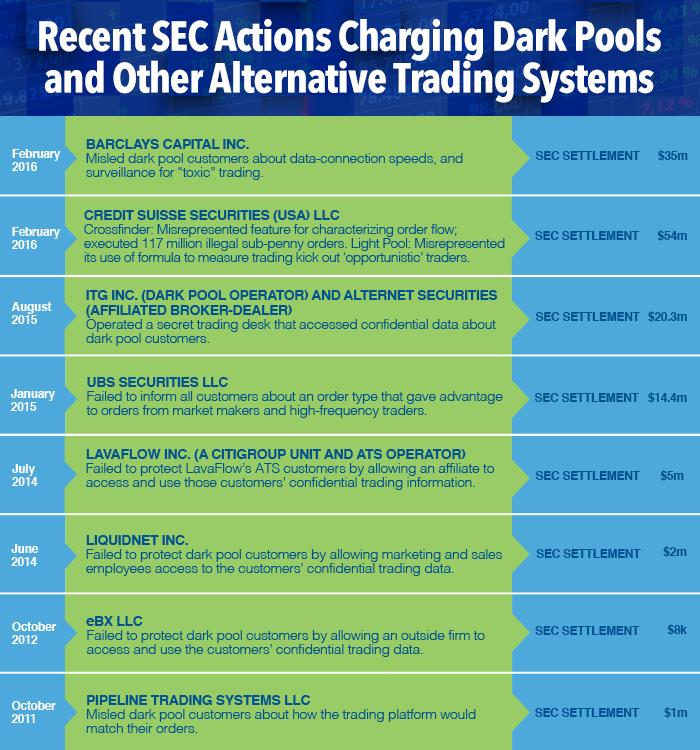
Barclays and Credit Suisse have agreed to settle federal and state charges that they violated federal securities laws while operating alternative trading systems known as “dark pools,” with Barclays admitting it broke the law, federal and state officials said Sunday.
Dark pools allow investors to trade large blocks of shares but keep the prices private.
Barclays will pay a penalty of $70 million, split equally between the state of New York and the Securities and Exchange Commission, and it will install an independent monitor to ensure proper operation of its electronic trading division.
Credit Suisse agreed to settle the charges by paying a $30 million penalty to the SEC, a $30 million penalty to the state of New York, and $24.3 million in disgorgement and prejudgment interest to the SEC for a total of $84.3 million. Disgorgement is the repayment of ill-gotten gains that is imposed on wrongdoers by the courts.
“Dark pools have a significant role in today’s equity marketplace, and the firms that run these venues must ensure that they do not make misstatements to subscribers about their material operations,” said Andrew Ceresney, director of the SEC’s Enforcement Division. “These largest-ever penalties imposed in SEC cases involving two of the largest ATSs show that firms pay a steep price when they mislead subscribers.”
Barclays and Credit Suisse allegedly misled investors in the dark pools, saying they would be protected from predatory high-frequency trading tactics, federal and state charged following investigations.
"These cases mark the first major victory in the fight to combat fraud in dark pool trading and bring meaningful reforms to protect investors from predatory, high-frequency traders," New York Attorney General Eric Schneiderman said. "This effort, which began when we first sued Barclays, includes coordinated and aggressive government action which forced admissions of wrongdoing and record fines."
In March of 2014, Schneiderman called for tougher regulatory oversight and market reforms to eliminate unfair advantages provided to high-frequency traders at trading venues. He launched investigations into Credit Suisse and Barclays, the largest and second largest dark pool operators at the time.
In 2015, Schneiderman’s office filed a lawsuit alleging that Barclays made misrepresentations to investors about how, and for whose benefit, Barclays operated its dark pool called “Barclays LX,” and exposed its clients to the predatory traders from whom it promised to protect them. As a result of that fraud, Barclays grew its dark pool to be the second largest in the United States, he said.
The attorney general’s investigation found that Credit Suisse made misrepresentations concerning two equities trading venues, Crossfinder and Light Pool, operated by Credit Suisse’s Advanced Execution Services division.
Schneiderman also has reached agreements with Thomson Reuters, Business Wire, and others to end business practices that provided high frequency traders an unfair advantage.



