
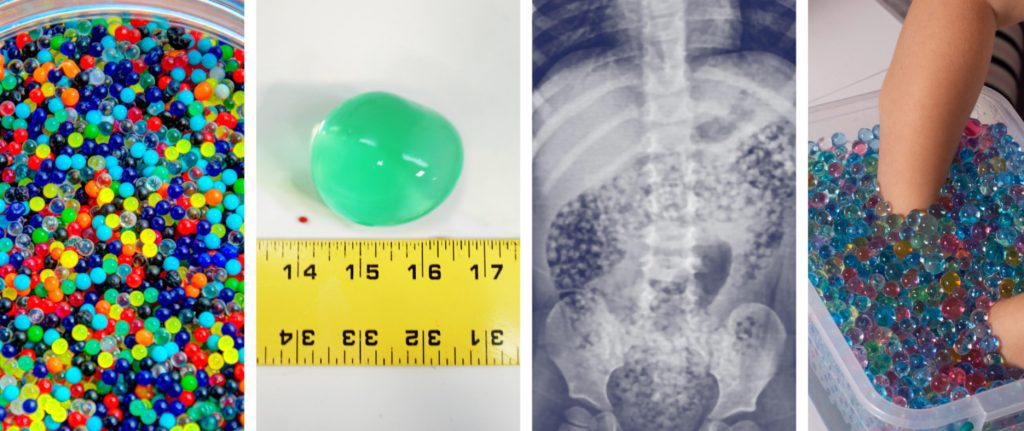
Water beads manufactured after March 12, 2026, need to meet the new federal performance, labeling, and testing requirements designed to reduce the risk of serious injury or death, the U.S. Consumer Product Safety Commission, or CPSC, said Thursday.
The new standard establishes:
- A maximum expansion size for water bead toys to prevent them from becoming large enough to cause blockages if ingested, and other injuries if inhaled or inserted into an ear or nose.
- Limits on the amount of allowable acrylamide in the products in an effort to reduce toxicity risks
- Strongly worded, visible warning labels to caution consumers.
Water beads are small, water-absorbing, often colorful balls of super absorbent polymer and can grow up to 100 times their original size when exposed to water. They’re often marketed and sold as toys, sensory tools, crafts, and agricultural products.
“This new rule establishes clear safety standards for water beads and gives the CPSC officials at our nation’s ports the tools they need to quickly identify noncompliant products and stop dangerous shipments before they reach American homes,” CPSC Acting Chairman Peter A. Feldman said in a statement.
Feldman said water beads that fail to meet the new federal standards are now illegal to sell in the United States, and manufacturers of these products, most of whom are based in China, must meet the new federal standard or face CPSC enforcement.”
The CPSC data show that from 2017 to 2022, an estimated 6,300 water bead-related ingestion injuries were treated in U.S. emergency departments, and there was at least one reported death, a 10-month-old girl in 2023.
Consumer Reports, a testing and advocacy group, welcomes the CPSC’s water beads rule as an important victory for child safety, and it applauds the agency for taking strong action.
“However, parents should stay vigilant,” Gabe Knight, senior policy analyst for Consumer Reports, said in a statement. “Water beads send thousands of children to the ER every year, and they remain in countless homes across the country.”
Knight said it’s also important to remember that illegal products frequently pop up on online marketplaces.
“We strongly urge the CPSC and online marketplaces to strictly enforce the new rule, and we remind parents to never let a young child play with water beads, whether or not they meet the new standard,” she said.
A recent Consumer Reports evaluation found hazardous water beads marketed to children for sale on major platforms, including Amazon and Walmart. Even though listings were removed after Consumer Reports flagged them for the platforms, the findings highlight a clear need for stronger marketplace oversight, Knight said.
Consumer Reports urges platforms to deploy all means possible to proactively keep hazardous products off their platforms.
Water bead safety tips
- Remove water beads from any area where young children may be present.
- Store water beads in a secure container and location where young children can’t easily access them.
- Don’t allow children to play with water beads unsupervised.
- Discard the product if water beads start to come out of it, such as a ball filled with them.
- Clean the area and remove any beads that may have rolled away after use as water beads can easily scatter, roll and become lost.
- Keep water bead products that aren’t marketed as children’s toys and fall outside the scope of this rule out of spaces where children live or play.
Keeping these safety tips in mind can help protect you and your family from needles pain and suffering and financial woes. Water beads can cause life-threatening intestinal blockages if swallowed, or severe – sometimes permanent – injuries if inserted into an ear or a nose.



