
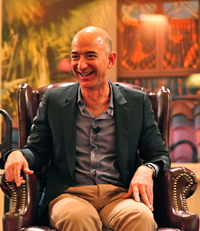
Photo: Steve Jurvetson
As a journalist, I’m skeptical that the billionaire founder of Amazon.com, Jeff Bezos, will be able to save The Washington Post let alone journalism.
When it was announced that Bezos himself, not Amazon.com, bought The Post, many news commentators were all aglow with how he was going to come up with some innovation to make the newspaper more profitable, and in the long run, save journalism.
Although saddened, even Bob Woodward, a Post associate editor who, along with his partner Carl Bernstein under the leadership of Executive Editor Ben Bradlee, led The Post to a Pulitzer Prize for their investigation of Richard Nixon’s crime-ridden White House, thinks Bezos is the man for the job:
But if there’s somebody who can succeed, it’s Bezos. He’s the innovator, he’s got the money and the patience, so we’ll see. I think in some ways, this may be The Post’s last chance to survive, at least in some form of what it was.
When he purchased The Post for $25 million, Bezos said:
There will, of course, be change at The Post over the coming years. That’s essential and would have happened with or without new ownership. The Internet is transforming almost every element of the news business: shortening news cycles, eroding long-reliable revenue sources, and enabling new kinds of competition, some of which bear little or no news-gathering costs.
There is no map, and charting a path ahead will not be easy. We will need to invent, which means we will need to experiment. Our touchstone will be readers, understanding what they care about – government, local leaders, restaurant openings, scout troops, businesses, charities, governors, sports – and working backwards from there. I’m excited and optimistic about the opportunity for invention.
Donald Graham, Washington Post Co. chairman, in a letter about the sale, said The Post had innovated:
As the newspaper business continued to bring up questions to which we have no answers, Katharine and I began to ask ourselves if our small public company was still the best home for the newspaper. Our revenues had declined seven years in a row. We had innovated, and to my critical eye our innovations had been quite successful in audience and in quality, but they hadn’t made up for the revenue decline. Our answer had to be cost cuts, and we knew there was a limit to that. We were certain the paper would survive under our ownership, but we wanted it to do more than that. We wanted it to succeed.
Some speculate that one of reasons the Graham family sold the newspaper because it was counting on its for-profit company, Kaplan University, to continue to make up for losses being incurred by The Post.
However, when the federal government began to crack down on for-profit colleges, including Kaplan University, due to a long history of reports of degrees of questionable value, huge student loan debts, and preying on poor black students and veterans, the Graham’s “cash cow” could have been weakened.
See Accuracy in Media’s article, “Scandal at The Washington Post: Fraud, Lobbying, and Insider Trading,” for details on the Graham family’s “innovations” with Kaplan University.
So why did Bezos buy The Post?
To use the newspaper as a political tool, to gain political clout, to gain assets, or to leave a legacy are among the reasons listed in the article “This Week in Review: Why Bezos Is Buying The Washington Post and What’s Next for It.”
As for what’s next for The Post, I and others have concerns that Bezos will do away with The Post’s printed newspaper.
This past November, Bezos said in an interview with the German newspaper Berliner Zeitung, “One thing I’m certain about: There won’t be printed newspapers in 20 years.”
Granted, newspaper revenues are declining. But how much profit do newspapers need to make?
When I began work as a journalist in the 1970s, I was surprised to learn that newspapers were quite profitable businesses, usually making a 15 percent profit.
When a recession or two came along and advertising revenue dropped, cutting staff was common.
Even now, some newspapers are making money.
Despite all the talk about newspapers being a dying business, plenty of them are profitable, said Nat Ives in the Ad Age article, “A Look at Newspapers Turning a Profit – Yes, There Are Some – and Those That Are Not.”
Ives lists The New York Times, The Wall Street Journal, and the Omaha World-Herald as profitable.
Unprofitable, he said, are The New York Post, The Times of London, and The Guardian.
Instead of closing, Florida’s Naples Daily News, California’s Santa Rosa Press Democrat, The Deseret News in Salt Lake City, and The Columbia Daily Herald in Tennessee have all seen revenues improve over the last few years, according to the Pew Research Journalism Project.
It’s too early to tell what changes are occurring at The Post since Bezos bought it. We’ll just have to wait and see.
It might be better for Bezos to stick with managing Amazon.com.
I recently placed an order and Amazon and one of its affiliate companies said the order would arrive in three to five days. I had an entire week before I needed my new camera lens to take photos at events – plenty of time, I thought.
However, it took a week for the lens to arrive, so I missed having it when I needed it.
And, Amazon delivering packages by drone? I don’t think so.
Drones drop bombs effectively. I can’t imagine a package surviving being dropped in a yard or driveway. Or, how about an apartment house?



My theory is that the future of newspapers is going to go either the non-profit route (kind of like NPR) or else become a play toy of the rich (kind of like sports teams and foundations). So, obviously, we know which way the Post is going. Newspapers will be high-end publications, as opposed to free news on the Internet, used not for profits but to further the cause of the special interest that owns them. In some ways this is good, in some ways bad. I guess time will tell …
Hi Tom,
You make a good point. I don’t like to think of newspapers as being the voice of the wealthy.
As a journalist, I’m disturbed by Rupert Murdock and the way Fox News slants the news. I think Murdock and Fox News encourage citizens to hate their government. We need people to participate in government and move forward to common goals to make progress in this country.
Rita