
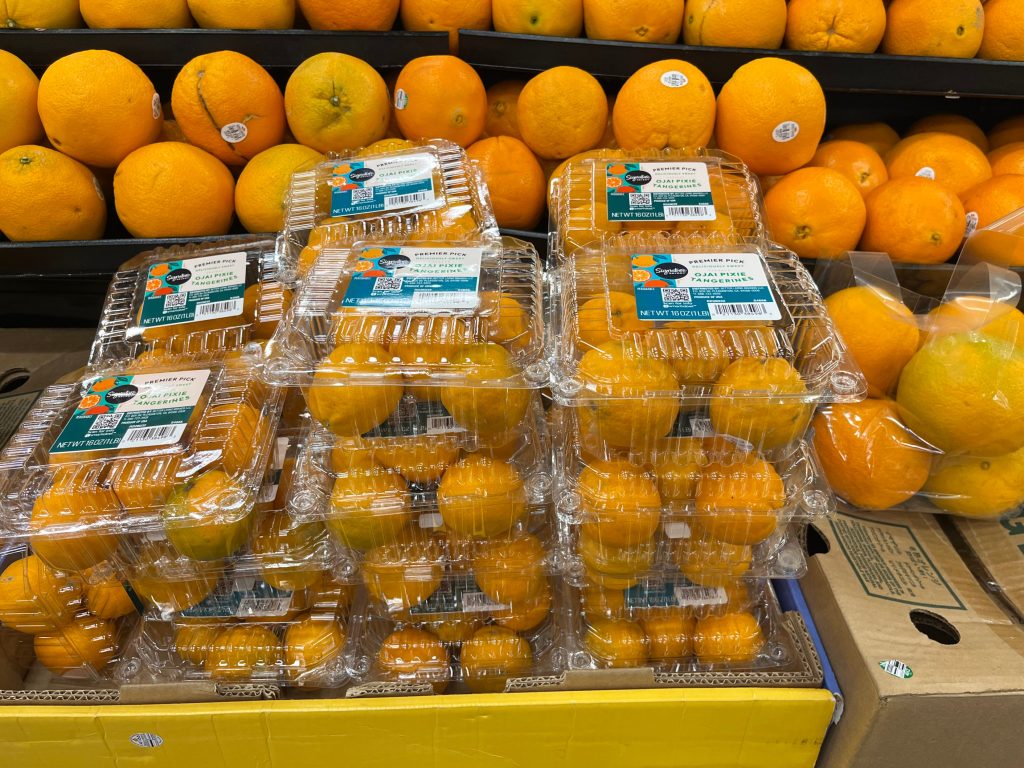
As more is being learned about the dangers of the plastic we eat and drink and as harm to the environment from plastic mounts, the amount of plastic being used in the produce section of grocery stores is increasing.
Four of the top five largest grocers by market share – Walmart, Kroger, Costco, and Amazon – were among the top five most plastic intensive retailers, according to a new survey by the U.S. PIRG Education Fund and Environment America Research & Policy Center.
Called “Plastic in the Produce Aisle,” the report by the two advocacy groups is based on a survey looking at the packaging used for 10 types of herbs, fruits, and vegetables at 40 grocery stores in five U.S. cities. In those supermarkets, 81 percent of the surveyed produce was sold with plastic packaging including “clamshell” containers, mesh bags, film, trays, and twist-ties. Only 12 percent of surveyed produce came with no plastic.
You can reduce the amount plastic you and your family buy, use, and consume by:
- Bringing your own bags to the store and avoiding using the unnecessary plastic bags offered in the produce aisle. In addition to reusable grocery bags, special produce bags are available that you can buy, which are lighter and washable.
- Voting with your wallet to choose loose, unpackaged produce whenever possible.
- Choosing non-plastic packaging, such as fiber – for example, cardboard or paper bag – products if an unpackaged product isn’t available.
- Avoiding rigid plastic packaging whenever possible as these containers use more plastic per unit of food than film or ties.
- Signing up for Ridwell, a company that will pick up many types of plastic from your home for a fee. It’s available in parts of California, Colorado, Georgia, Minnesota, Oregon, Texas, and Wisconsin. The company makes products, such as decking, from the plastic.
“Plastic waste is spreading throughout our environment at alarming rates,” said Jonathan Kaplan, policy analyst with U.S. PIRG Education Fund and co-author of the report.“The produce aisle turns out to be a great place to take action on plastic pollution.”
The produce industry doesn’t need to cover the natural peels, skins, and shells of fruits and vegetables with unnecessary single-use plastic packaging, Kaplan said.
To demonstrate the abundance of plastic free alternatives, the groups modeled a theoretical low plastic store and gave it the lowest plastic score for each category that they found in all the real stores surveyed.If all grocers used the best packaging solutions already being demonstrated by the stores visited, the average plastic intensity score for all companies would drop by 73 percent.
The report recommends that retailers and produce packers should rapidly expand the plastic-free or less plastic-intensive packaging solutions that are already found in many stores across the country.
In addition, the report recommends that policy makers expand existing grocery bag bans to more states and that bans should apply to plastic bags offered in the produce aisle. And, policy makers should also phase out plastic packaging on produce categories that can be sold loose and phase out the use of non-compostable plastic stickers on produce.
Plastic pollution is a threat to public health and the health of the planet. Action is needed from the produce industry, retailers, and consumers to address these threats.



Thank you for this post and for helping to raise awareness for what I believe is a very serious environmental problem looming in our near futures. Sure, plastics may “break down” into micro-pieces, to be carried on the wind, in the water and landscape — mostly invisible, but still ever-present and never fully integrating to become one with the environment. Or our bodies. Tiny inert wee foreign particles that will always be around — but unable to ever support life or the ecology, only contaminate it. Yes, plastics have enabled much convenience in our modern lives, but we may well find in time (sooner rather than later) that the costs of excessive use of plastics far exceed the benefits.
Yes, plastic is such a huge problem in the health of people and the environment. Policymakers have totally failed to deal with it. In Washington state, our Bottle Bill was canceled. Congress and state legislatures have never dealt with requiring manufacturers to reuse returned plastic or any other plastic regulations. I agree the cost of this public policy failure will be great.