
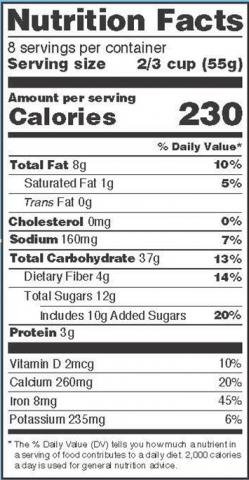
The updates to the Nutrition Facts Label are being delayed for 18 months by the U.S. Food and Drug Administration.
Consumers want the updated label – with the new line for added sugars, bolder presentation of calories, and more realistic serving sizes – sooner rather than later, a poll by Center for Science in the Public Interest found. It showed that 87 percent of Americans think the label updates are useful to them.
The updated labels will be required for large companies by January 2020, instead of the original date of July 2018, and for smaller companies by January 2021, instead of the original date of July 2019. Some parts of the food industry had asked for longer delays.
The labels are already on more than 29,000 products in grocery stores, and more appear weekly.


For another label, a new proposed rule would force certain manufacturers to label products that contain genetically modified ingredients.
Whether the GMO label should be required has been debated for years, and, in 2016, Congress passed a mandatory labeling law.
But the proposed rule by the U.S. Department of Agriculture isn’t as strong as consumers expected, according to an article in The Washington Post.
Food products may be exempted from labeling if they’re made with some refined genetically modified sugars and oils, or if a product contains those ingredients in amounts that fall below a threshold, according to a proposed rule released by the USDA recently. The proposed rule also allows food makers to use the term “bioengineered” to label such foods instead of “genetically modified,” a more recognizable term.
Food manufacturers will have three options to label foods made with GMO foods. It could be a one-liner on a label, such as “contains a bioengineered food ingredient,” or a standardized graphic – or a QR code, a bar code that can be read by a cell phone, that directs consumers to a webpage for information
“Replacing ‘GMO’ or ‘genetically-modified’ – terms that have been used by consumers for decades – with “bioengineered” is both disingenuous and deceptive to consumers,” said the Organic Insider. “The proposed bioengineered symbols – which are supposed to be neutral – give off the impression that ‘bioengineered’ foods are healthy.
The USDA is accepting comments about its proposed National Bioengineered Food Disclosure Standard until July 3.
Organic Insider recommends consumers offer these suggestions:
- The term “bioengineered” shouldn’t be used. It’s both misleading and confusing to consumers. “GMO,” “GE,” or “genetic engineering” should be used instead. These are terms consumers are familiar with and understand.
- All forms of genetic engineering should be disclosed, including gene-editing, synthetic biology, and RNAi.
- All highly processed foods, such as genetically engineered oils, syrups, and sugars, shouldn’t be excluded from labeling.
- Any symbol that represents “bioengineered” should be neutral and not contain a smiley face or a sun.
The USDA’s rule is expected to be finalized this summer.



Of course bigAg will get what it wants. BigAg would like GMO foods to be able to fall into the organic category. Maybe not roundup ready, etal products, but anything else, golden rice, etc.
Given who’s in the WH & therefore who he’s appointed to head federal agencies, what else would anyone expect?
Terrump’s alleged “populism” has never been more then a facade.
Hi Azure,
You’re right. It’s very discouraging how the Trump administration is appointing agency heads who are dismantling public policies that benefit consumers. Changing GMO icons into “biologically engineered” cute “BE” stickers is terrible. My advice? Buy organic.
Rita
The Trump administration is deregulating everything that has to do with consumer and environmental safety all in the name of money. The sooner they are out, the better. Everyone’s vote counts.
Hi Rebecca,
You are so right. Trump lied when he said he’d help ordinary citizens. It’s the rich and wealthy, including his own businesses that he wants to help. These label changes could effect people’s health. The changes being proposed to the Consumer Financial Protection Bureau will harm their pocketbook.
Rita