In many homes, accumulating printed photos are a problem.
They’re stuck here and there, while consumers think they’ll organize them
later.
My advice is to pick out a system and start organizing your
photos today. Then, keep up with new photos as they come in.
When I was organizing my garage recently, I discovered two
huge boxes of photos, cards, and letters from the 1960s and 70s.
I invited some friends over Friday, asking them to bring a
box of their photos to work on to keep me company while I worked on mine.
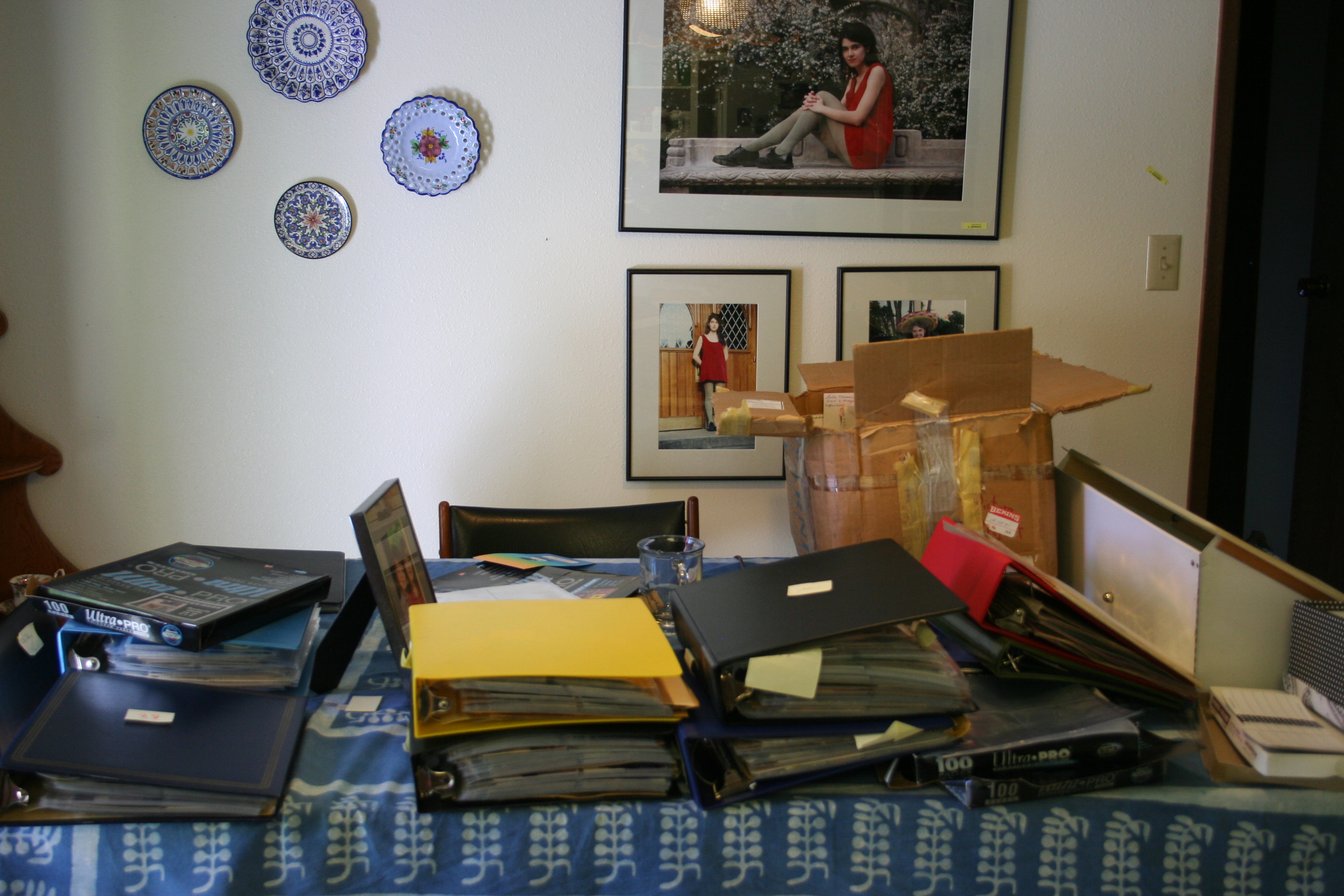
The photo above shows the first box, almost empty, and the
notebooks I added the photos and some of the cards to.
If you need to organize your photos, here are some
methods to consider:
Printed photos
Photo boxes
These work well for photos up to 4 x 6 inches. The boxes,
usually about 4 ¼ x 7 1/8 x 10 ½ inches, work especially well if you don’t save
your negatives. You can sort your photos according to year or topic, then stack the boxes in closets. If you want to keep your negatives, they can be placed in archival
pages, folded, then put along the edge of the photos.
Some photo boxes come with dividers, others don’t.
If you want to show your photos to others, you can more
easily make albums if your photos are organized and stored together in photo
boxes.
When working on my big photo project, I decided to buy photo
boxes to put letters in. I found the boxes on sale at Michaels and Jo-Ann
Fabric and Craft for $2 each, a good price.
Photo albums
You can purchase albums at photo, big box, department, and
drug stores. Look for ones that are archival quality, with acid-free and PVC
free pages. Make sure you can buy replacement pages. While albums work well,
they are often larger than 8 ½ x 11 inches, expensive, and hard to store.
Archival pages inserted in notebooks
This is the method I use. I buy archival-quality, plastic
pages with pockets for 3 x 5 inch, 4 x 6 inch, 5 x 7 inch, and 8 x 10 inch photos. After I put the photos in the pages, I insert them in three ring
binders according to year. I also buy pages for negatives, which I put after
the corresponding set of photos. You can also get archival pages for slides.
Scrapbooking
If you have lots of time, you can buy all kinds of materials
and tools to decorate albums to put your photos in. For me, this is too time
consuming and expensive. Also, where to store all the materials could be a
problem.
If scrapbooking interests you, you can find resources, and
even clubs and retreats, to help you get started.
Things to avoid for printed photos
- Don’t leave the photos in the envelopes they come in from
the store.
- Don’t use paperclips, tape, or sticky notes on your photos. Also, don’t use rubber bands around stacks of photos.
- Don’t write on photos with non-archival pens.
- Throw away your bad photos, unless it’s a one-of-a-kind or
has special meaning.
Digital photos
While digital photos have made the stacks of unorganized
photos less of a problem for some, digital methods of photo organization also
are needed.
To organize my digital photos, I use iPhoto, which came with
my Apple desktop. I upload photos from my camera, and label the events. iPhoto
organizes the photos chromatically.
Using iPhoto, I can crop photos, straighten them, and make
them lighter or darker.
When I want to use photos on my blogs or have prints made of
them, I get them out of iPhoto and name them. After I use them, I put them into
folders that I’ve created such as Family, Food, Natural Disasters, Retirement,
Reunions, Sports, Toys, Travel, Scenery, Airplanes, Clothing, Community Events,
Flowers, Gardening, and Furniture.
Other digital organizing options are Picasa, Windows Live
Photo Gallery, Adobe Photoshop Elements, Adobe Photoshop Lightroom, and ACDSee.
Be sure to have a system to backup your digital photos.
Digital photos will fill up your hard drive fast and could crash your computer
if you don’t keep an eye on it.
I’ve just purchased an external hard and will use the
Apple’s Time Machine function to back up my photos. As a photojournalist, I
have thousands of photos.
Good luck with your photos. I love photos, and I’ve worked
three straight days getting the two boxes I found organized.
I’ve also made progress because I made a decision about what
to do with letters. I need to organize my mom and dad’s letters, too. It’s
important to me to keep them because they offer such great family history. I
have letters that my parents wrote to each other when they were courting in the
1930s. When I get them organized in boxes, I’ll be able to find them when I
write a family history.
In addition, I’ve decided what to do with cards. I’m filing
some in archival pages along with my photos, discarding others, and giving some to my daughters.