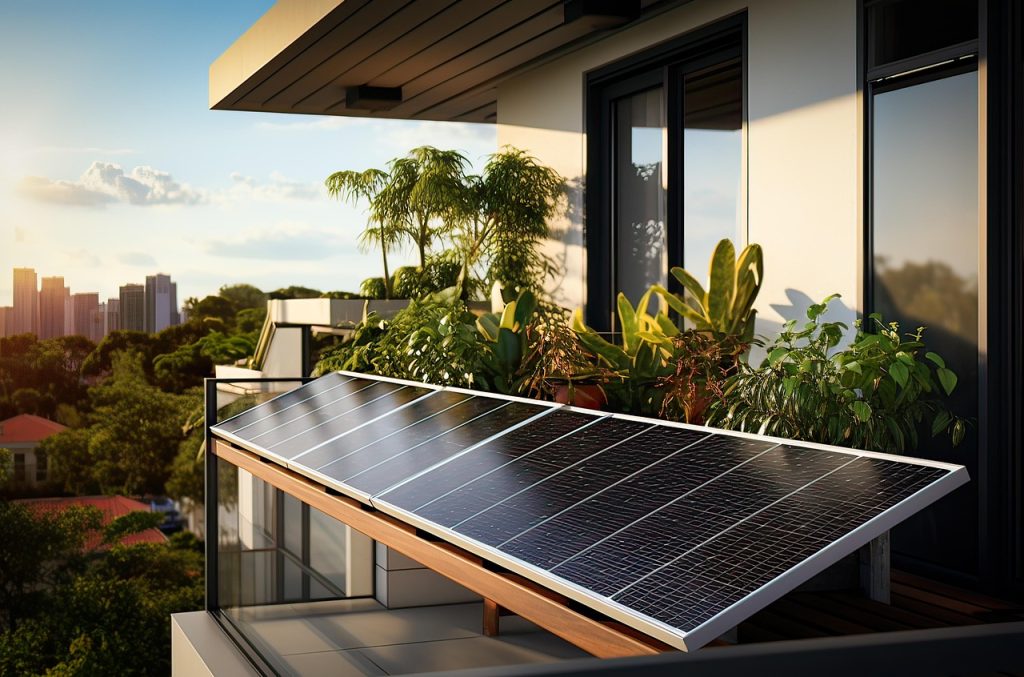
Californians will be able to invest in clean energy and tackle high energy bills by making it easier to install small, affordable “balcony solar” systems under Senate Bill 868, the Plug and Play Solar Act.
“This new law will deliver cleaner power, greater energy independence and real savings for consumers,” Bernadette Del Chiaro, senior vice president for California for the Environmental Working Group, or EWG, an advocacy organization, said in a statement.
Lifting regulatory barriers
Balcony solar is thriving in Europe. In Germany, more than 4 million systems have been installed, and efforts to ease their installation are gathering steam in other countries.
California is the 10th state to legalize balcony solar and has doubled the size of the U.S. market with this one bill. Utah became the first, in 2025. Other states include New Jersey, Virginia, Maryland, Colorado, Connecticut, Utah, Maine, New Hampshire, and Vermont.
Homeowners and renters will now be able to buy qualified portable balcony solar panels from retailers and plug them in without first having to get an interconnection agreement from their utility. The cost and time involved with getting that agreement has been a barrier to greater use of these systems, Del Chiaro said.
With language sought by the utilities, the assembly added a provision ending the interconnection exemption on Jan. 1, 2030.
Solving an urgent public health problem
California is experiencing more frequent and dangerous heat days, with extreme heat events up 55 percent statewide, threatening public health and safety without access to cooling, a recent EWG report showed.
Balcony solar is one solution, helping lower electricity costs and making it cheaper to run needed cooling.
“These small, easy-to-use solar panels will give everyone, including renters, the relief they desperately need on our outrageous energy bills,” said the bill’s author Sen. Scott Wiener (D-San Francisco). “Electricity costs have reached ridiculous levels here in California, and now that the Plug and Play Solar Act is law, Californians have a much-needed tool to provide relief.”
Wiener said it’s time to put money back in the pockets of Californians.
California electricity rates have nearly doubled over the past decade, making it the nation’s second-highest energy prices.
A single 400-watt balcony solar system can cover about 14 percent of the average apartment’s electricity usage, providing savings of about $250 per year. While the cost of balcony solar costs about $500 today, with broader use enabled by SB 868, costs are expected to fall.
Safety requirements
SB 868 ensures these plug-and-play systems meet strict safety standards. All systems need to be certified by the global independent safety science company Underwriters Laboratories, or an equivalent national testing lab. To protect utility workers, systems must automatically shut off within seconds if the grid goes down.
System size is capped at 1,200 watts, enough to power everyday appliances, such as refrigerators, lights, Wi-Fi routers, and AC units.
“With Gov. Newsom’s signature making SB 868 law, California can now use the power of its enormous market to dramatically accelerate the adoption of this technology, Del Chiaro said. “It will cut energy costs, expand access to clean power and tackle climate change.”