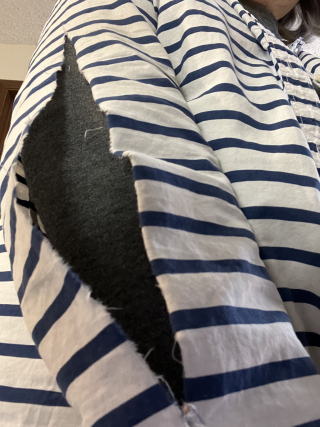
One way to save money is to repair your clothes rather than buying new ones.
Clothes usually have an average life of two years, but if you can stretch that out to three years, it reduces the use of resources. That’s good for the budget.
It also makes good sense environmentally.
In the United States, more than 11 million tons of textile waste end up in landfills each year. On average, Americans throw away 81 pounds of clothing per person annually. Only about 15 percent of unwanted textiles are recycled or donated, meaning the vast majority are trashed.
On buttons, I learned how to sew them on using a shank in home economics classes in high school. However, as a busy person, I don’t often take the time to sew on buttons. I resort to safety pins and even small clips.
However, sewing on buttons is easy.
Here are the steps from the University of Florida’s IFAS Extension:
- Cut about 16 inches of thread and thread it double through your needle and knot the end.
- If you are replacing a button, you should see clearly where to sew it. On the wrong side of the fabric (the inside of your garment), put your needle down into the fabric and come up to the right side of the fabric.
- Thread the needle through one side of the button. Make sure the button is centered on the mark and put the needle back down through the opposite hole and into the fabric.
- To create a shank, place a toothpick or a needle under the thread where you are going from hole to hole of the button. Stitch through the holes a few more times.
- Finally, to finish it off, bring the needle up to the top but not through the buttonhole. Wrap the thread around the stitches a few times tightly. Pass the needle to the inside of the garment and knot it off.
Maybe 2026 will be the year I’ll do better with sewing on buttons. It’s really easy.