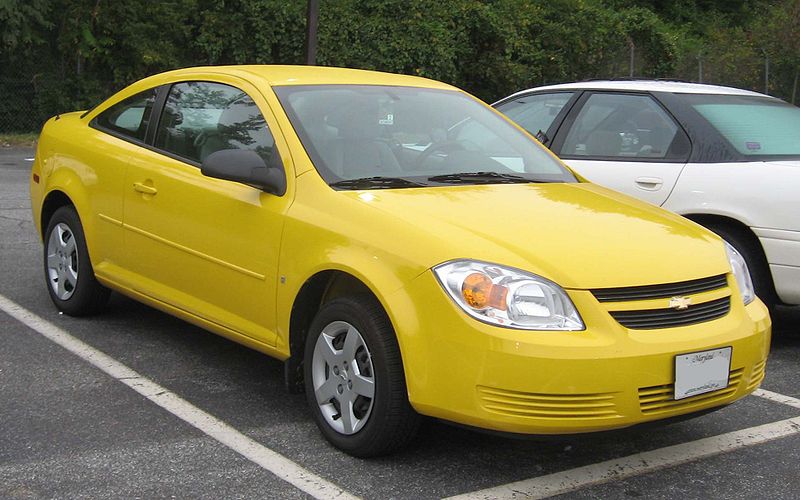
Photo: IFCAR
The federal government has filed criminal charges against General Motors Co., saying it concealed a potentially deadly safety defect from its U.S. regulator, the National Highway Traffic Safety Administration, from the spring of 2012 through February 2014, and mislead consumers about the safety of some its cars.
The defect consisted of an ignition switch that had been designed and manufactured with too-low torque resistance and could move easily out of the “Run” position into “Accessory” or “Off.”
When the switch moved out of Run, it could disable the car’s frontal airbags – increasing the risk of death and serious injury in some types of crashes.
The number of deaths due to the defective switch is at least 174, according to a Washington Post article.
General Motors agreed to a deferred prosecution agreement, which imposes an independent monitor on the company to review and assess policies, practices, and procedures relating to its safety-related public statements, sharing of engineering data, and recall processes. The agreement also requires General Motors to transfer $900 million to the United States by Sept. 24, 2015.
If General Motors abides by the terms of the agreement, the government will defer prosecution for three years and then seek to dismiss the charges.
“Every consumer has the right to expect that car manufacturers are taking their safety seriously,” said U.S. Attorney General Loretta Lynch. “The Department of Justice is committed to ensuring that the products Americans buy are safe; that consumers are protected from harm; and that auto companies follow the law.”
“For nearly two years, GM failed to disclose a deadly safety defect to the public and its regulator,” said U.S. Attorney Preet Bharara. “By doing so, GM put its customers and the driving public at serious risk. Justice requires the filing of criminal charges, detailed admissions, a significant financial penalty, and the appointment of a federal monitor. These measures are designed to make sure that this never happens again.”
Special Inspector General Christy Goldsmith Romero for the Troubled Asset Relief Program said “Americans stepped up and bailed out General Motors with $50 billion and General Motors must step up and make substantial corporate changes to prevent anything like this from happening again.”
The allegations
Early knowledge of the defective switch
General Motors engineers knew before the defective switch went into production in 2002 that it was prone to easy movement out of the Run position. But the engineer in charge of the defective switch approved its production anyway.
In 2004 and 2005, as General Motors employees, media representatives, and General Motors customers began to experience sudden stalls and engine shutoffs caused by the defective switch, the company considered fixing the problem. However, having decided that the switch didn’t pose a safety concern, and citing cost and other factors, engineers responsible for decision-making on the issue opted to leave the defective switch as it was and issue an advisory to dealerships with tips on how to minimize the risk of unexpected movement out of the Run position. General Motors even rejected a simple improvement to the head of the key that would have significantly reduced unexpected shutoffs at a price of less than a dollar a car.
At the same time, in June 2005, General Motors made public statements that, while acknowledging the existence of the defective switch, gave assurance that the defect didn’t pose a safety concern.
General Motors knowledge that the defective switch causes airbag non-deployment
By the spring of 2012, General Motors knew that the defective switch presented a safety defect because it could cause airbag non-deployment in some General Motors cars. General Motors personnel investigating the cause of a series of airbag non-deployment incidents learned that the defective switch could cause frontal airbag non-deployment in at least some model years of the Cobalt, and were aware of several fatal incidents and serious injuries that occurred as a result of accidents in which the defective switch may have caused or contributed to airbag non-deployment. This knowledge extended well above the ranks of investigating engineers to certain supervisors and attorneys at the company.
General Motors failure to disclose the defect and recall affected cars
Not until about 20 months later, in February 2014, did General Motors first notify NHTSA and the public of the connection it had identified between the defective switch and airbag non-deployment incidents. The company disregarded NHTSA’s five-day regulatory reporting requirement for safety defects.
In addition, for most of the period during which General Motors failed to disclose this safety defect, it not only failed to correct its June 2005 assurance that the defective switch posed no safety concern but also actively touted the reliability and safety of cars equipped with the defective switch, with a view to promoting sales of used General Motors cars. Although it sold no new cars equipped with the defective switch during this period, General Motors dealers were still, from about the spring of 2012 through the spring of 2013, selling pre-owned Chevrolet, Pontiac, and Saturn brand cars that would later become subject to the February 2014 recalls. These sales were accompanied by certifications from General Motors, assuring consumers that the vehicles’ components, including their ignition systems and keys, met all safety standards.
General Motors delay in disclosing the defect was the product of actions by personnel responsible for shepherding safety defects through the company’s internal recall process, who delayed the recall until it could fully package, present, explain, and handle the deadly problem.
Rather than move swiftly and efficiently toward recall of at the cars known to be affected by the safety defect and destined for recall, General Motors personnel took steps to keep the company’s internal investigation into airbag non-deployment caused by the defective switch “offline” – outside of the company’s regular recall process.
In addition, on at least two occasions while the defective switch condition was well known by some within General Motors but not disclosed to the public or NHTSA, company personnel made incomplete and misleading presentations to NHTSA assuring the regulator that it would and did act promptly, effectively, and in accordance with its formal recall policy to respond to safety problems – including airbag-related safety defects.
Criminal prosecution of individuals
In a news conference Thursday, Bharara said prosecutors’ hands were tied by what the law could allow in relation to the prosecution of individuals, according to the Washington Post article “Why General Motors $900 Million Fine for a Deadly Defect Is Just a Slap on the Wrist.”
The article said “15 executives deemed complicit in mishandling the defect have been ‘forced out.’”
Court documents in the settlement didn’t name the General Motors employees who concealed information from regulators, but did mention a safety director and a safety engineer, according to The New York Times article, “$900 Million Penalty for G.M.’s Deadly Defect Leaves Many Cold.” The Times said it was unable to reach two employees who had been dismissed last year whose jobs matched those described in the lawsuit.
Cars with the defective switch
The models equipped with the defective switch were the 2005, 2006, and 2007 Chevrolet Cobalt; 2005, 2006, and 2007 Pontiac G5; 2003, 2004, 2005, 2006, and 2007 Saturn Ion; 2006 and 2007 Chevrolet HHR; 2007 Saturn Sky; and 2006 and 2007 Pontiac Solstice.