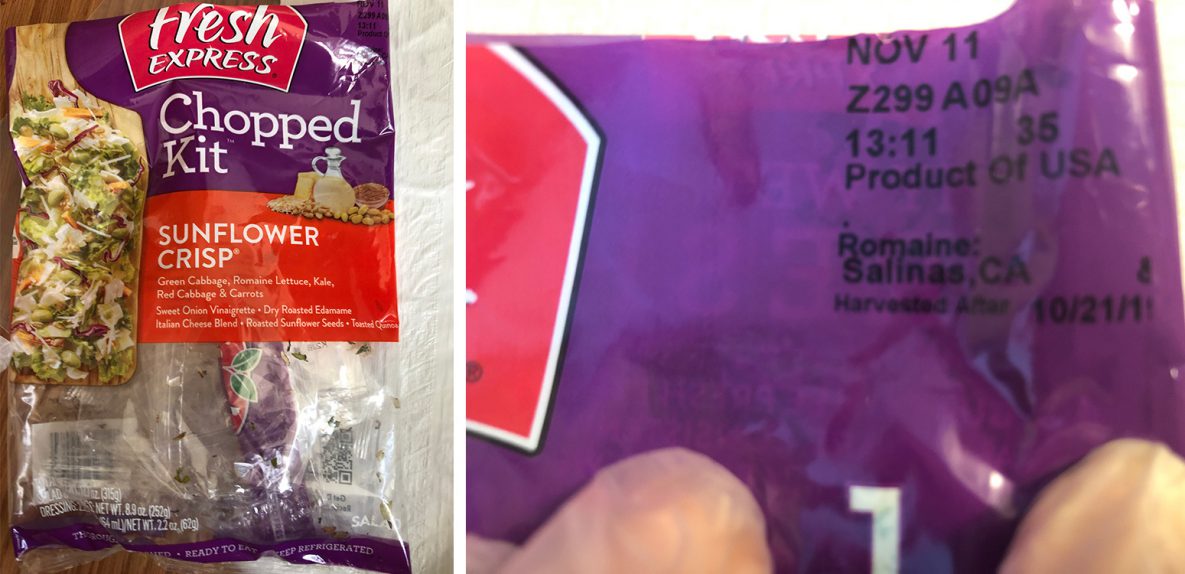
State and federal agencies are investigating a multistate outbreak of E. coli O157:H7 infections linked to Fresh Express Sunflower Crisp chopped salad kits. The eight people infected are from North Dakota, Wisconsin, and Minnesota.
Consumers shouldn’t eat food from the salad kits with this identifying information: UPC 0 71279 30906 4, beginning with lot code Z, and a best-before date up to and including 07DEC19. This information is printed on the front of the bag in the top right corner.
Health officials advise consumers to check their refrigerators for the salad kits. If they find one, they should:
- Not eat it. Throw it away. Even if some of the kit was eaten and no one got sick, throw the rest away.
- Wash and sanitize drawers or shelves in refrigerators where the salad kit was stored. Follow these five steps to clean your refrigerator.
Take action if you have symptoms of an E. coli infection.
- Talk to your healthcare provider.
- Write down what you ate in the week before you started to get sick.
- Report your illness to your local health department.
- Assist public health investigators by answering questions about your illness.
- Wash your hands thoroughly after changing diapers, using the toilet, and before and after preparing food to lower the chance of infecting others.
Of the eight people infected with the outbreak strain of E. coli, three people have been hospitalized. One person has developed hemolytic uremic syndrome, a type of kidney failure. No deaths have been reported.
Information collected so far indicates that Fresh Express Sunflower Crisp chopped salad kits are a likely source of the outbreak. The investigation is ongoing to determine what ingredient in the salad kit was contaminated.
Romaine lettuce is one of the ingredients in the salad kit, but the Centers for Disease Control and Prevention said it doesn’t know if this outbreak is related to a current outbreak linked to romaine lettuce from the Salinas, California, growing region. Preliminary information indicates that romaine lettuce in the salad kits eaten by some of the sick people likely came from the Salinas growing region, the CDC said in its Food Safety Alert.
The CDC will provide more information as it becomes available.
Information about E. coli infection is:
- People usually get sick from Shiga toxin-producing E. coli two to eight days, an average of three to four days, after swallowing the germ.
- Some people with E. coli infections may get a type of kidney failure called hemolytic uremic syndrome.
- E. coli infection is usually diagnosed by testing a stool sample.
- Antibiotics aren’t recommended for patients with suspected E. coli infections until diagnostic testing can be performed and E. coli infection is ruled out. Some studies have shown that administering antibiotics to patients with E. coli infections might increase their risk of developing HUS, and a benefit of treatment with antibiotics hasn’t been demonstrated.
For more information, see Symptoms of E. coli Infection.