
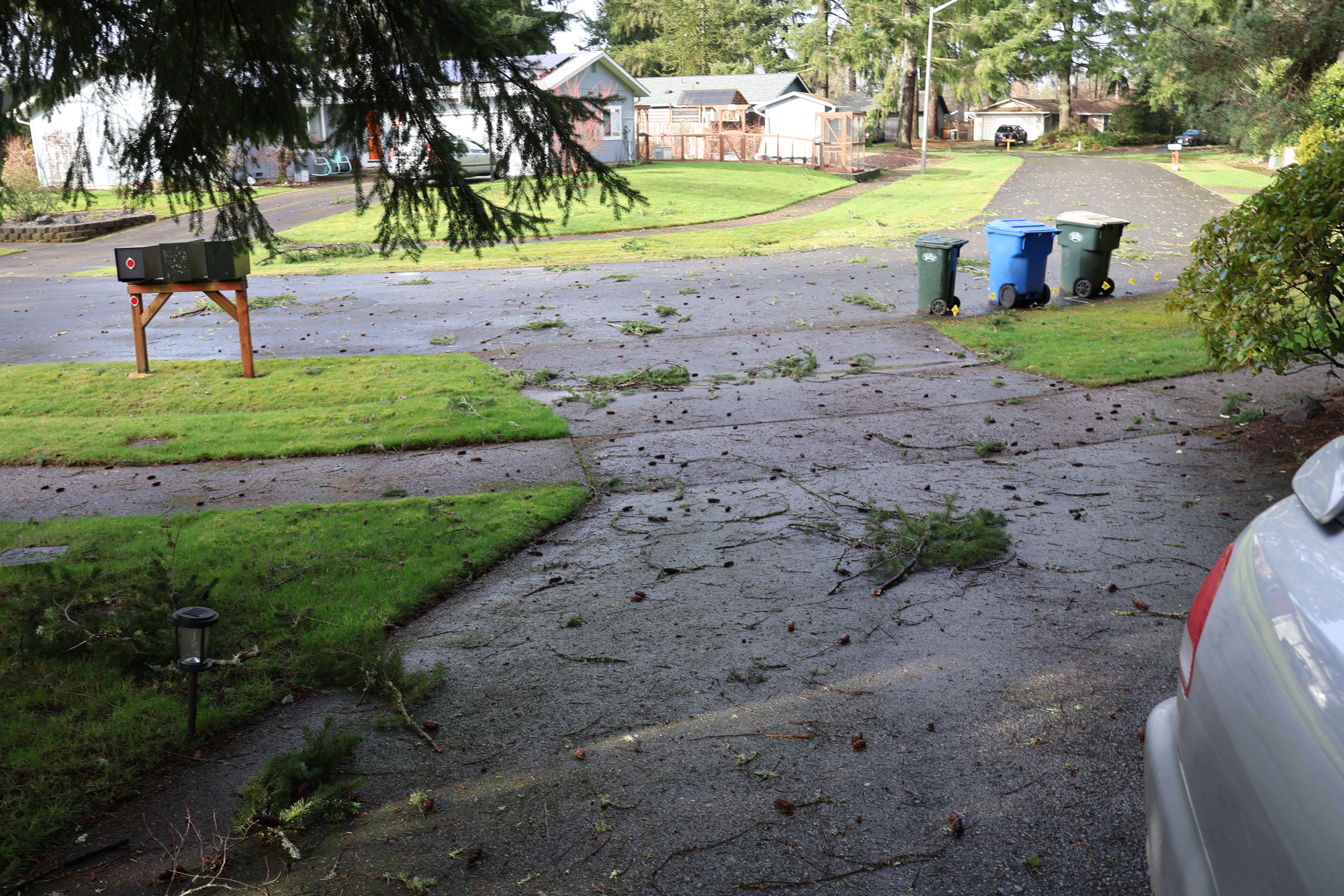
 My daughter Lisa is visiting from Madrid, and we took a road trip to Portland, Oregon, to spend time with my oldest daughter Mona, who was visiting a friend near Portland.
I’d read an atmospheric river was headed to the Pacific Northwest in a New York Times article. Although I was concerned, we had heavy rains during our two-hour trip Sunday and good visibility.
As we were preparing to head home Tuesday, I read in The Seattle Times that 250,000 people were without power in Western Washington due to a storm Monday. I was hoping that it wouldn’t be us.
However, when we arrived home about 2:30 p.m., there was no power.
Small branches littered by driveway and a neighbor said the power went out about noon after a big storm Monday night.
I found a small flashlight on the emergency shelf in the closet so we could see in a couple of rooms that were dark. I also found a package of D batteries, so we got two other flashlights working quickly.
My big emergency light was charged up and ready to go, but my emergency radio wasn’t operational, and we didn’t take the time to figure out how to get it going.
I had a small portable charger, but although I thought it was charged, it wasn’t working. I looked through my desk, dresser drawers, and the emergency shelves and finally found a larger portable charger that we were going to get charged later.
Our priority was to watch my grandson Rafa play volleyball at 4 p.m. We used my laptop, which was fully charged, and the personal hot spot on my iPhone. We were able to watch the first set after a 20-minute delay. However, the game kept pausing, with the irritating circle continuing to come on. We watched the second set, also so, so slow, so we decided to give up and figure out how were doing to deal with no power.
We checked coffee shops where we could charge our devices and Lisa could walk so she could get in her 10,000 steps.
Before we left, I turned off the furnace and unplugged the power strips for my computer and the television. They can be damaged in power surges.
One coffee shop in downtown looked like a meeting was underway, so we headed to a Starbucks in Lacey where I’d charged my devices during a snow storm several years ago.
We bought herbal tea and cake and figured out a plan as our devices were charging.
When Starbucks closed at 8:30 p.m., we headed to O’Blarney’s Irish Pub for an Irish dinner that Lisa had been interested in.
We got lucky and enjoyed Irish music from a live band for more than an hour.
We decided we’d pile on the blankets and spend the night at the house, if the power didn’t come on. If it wasn’t on by Wednesday evening, we’d go to a motel for showers.
Lisa kept watching my cell phone, because Puget Sound Energy said they’d send us a text when the power came on.
However, my sense of it was that the power was back on and PSE had screwed up and not sent the message as promised.
Sure enough, I was right. The power was on and we were thrilled to be warm again.
Here are four ways to prepare yourself for a power outage from the Federal Emergency Management Agency:
Find alternate power source. Plan for batteries and alternative power sources to meet your needs when the power goes out, such as a portable charger or power bank. Have flashlights for every household member. Determine whether your home phone will work in a power outage and how long battery backup will last. Remember, never use a generator indoors.
Appliances. Disconnect appliances and electronics to avoid damage from electrical surges. Install carbon monoxide detectors with battery backup in central locations on every level of your home to avoid carbon monoxide poisoning.
Food storage. Keep freezers and refrigerators closed. A refrigerator will keep food cold for four hours. A full freezer will keep the temperature for about 48 hours. If you’re in doubt, monitor temperatures with a thermometer and throw out food if the temperature is 40 degrees or higher. Maintain a few days’ supply of nonperishable food and water.
Know your medical needs. If you rely on electricity for any medical needs, make a power outage plan for medical devices or refrigerated medicines. Find out how long medication can be stored at higher temperatures and get specific guidance for any medications that are critical for life.
If you’re without power during extreme temperatures, consider going to a community location to keep safe.
For more information on how to be prepared for a power outage, visit Ready.gov.



