
Where are pedestrians the safest?
During a recent visit to Miami, I wondered about it. I’ve begun walking for my health, and on walks in Miami, drivers didn’t wait for me to get through the crosswalk. When they had a free right turn, they’d dash through the crosswalk to see if they could beat me. Of course, they always did because they’re bigger. I’d pause so I wouldn’t get hit.
In Washington state, drivers are more polite. They usually wait for pedestrians to walk across the street when they’re in a crosswalk.
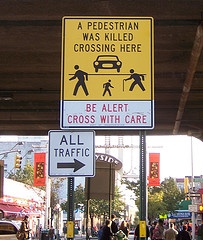
States with more than 150 pedestrian deaths or a fatality rate above 2.5 are Arizona, California, Florida, Georgia, Hawaii, Illinois, Michigan, New Jersey, New Mexico, New York, North Carolina, Pennsylvania, and Texas, according to “New Focus on Highway Safety” by A. George Ostensen on the Federal Highway Administration’s Web site. Cities in that category are Chicago, Detroit, Los Angeles, New York City, and Phoenix.
About 6,000 people die each year in pedestrian crashes.
Here are some pedestrian safety facts from Federal Highway Administration’s Pedestrian Safety Guide and Countermeasure Selection System.
- Pedestrian crash rates – crashes per 100,000 people – are the highest for 5- to 9-year-old males, who tend to dart out into the street.
- Males are more likely to be involved in a crash than females; in 2003, 69 percent of pedestrian fatalities were male, and the male pedestrian injury rate was 58 percent higher than for females.
- Rates for older persons – age 65 and older – are lower than for most age groups. This may be due to greater caution by older pedestrians – for example, less walking at night, fewer dart-outs – and a reduced amount of walking near traffic.
- Older adult pedestrians are more vulnerable to serious injury or death when struck by a motor vehicle than younger pedestrians. The percentage of crashes resulting in death is more than 20 percent for pedestrians age 75 or older, compared to less than 8 percent for those under age 14.
- Pedestrian crashes occur most frequently in urban areas where pedestrian activity and traffic volumes are greater than rural areas.
- Rural pedestrian crashes have a higher fatality rate. This is due to increased vehicle speeds found on rural roads and the fact that many rural areas have no sidewalks, paths, or shoulders for pedestrians to walk on.
- Sixty-five percent of crashes involving pedestrians occur at non-intersections.
- For ages 45 to 65, pedestrian crashes are about equal for intersections and non-intersections.
- Pedestrians age 65 and older are more likely to be injured or killed at intersections – 59 percent – compared to non-intersections – 41 percent. Older pedestrians tend to cross at intersections more often than younger ones.
- Most pedestrian crashes occur during morning and afternoon peak periods, when the traffic levels are highest.
- Fatal pedestrian crashes typically peak later in the day, between 5 p.m. and 11 p.m., when darkness and alcohol use are factors.
- Nearly half of all pedestrian fatalities occur on Friday, Saturday, or Sunday – 16 percent, 18 percent, and 13 percent, respectively.
- Crashes where older pedestrians are hit are more evenly distributed throughout the days of the week than those for younger ones. Older pedestrians are more likely to be struck during daylight hours.
- September through January have the highest number of nationwide pedestrian fatalities, with these months typically having fewer daylight hours and more poor weather. Child pedestrian fatalities are greatest in May, June, and July, due to an increase in outside activity.
- Speeding is a major factor in crashes of all types. In 2003, speeding was a contributing factor in 31 percent of all fatal crashes.
- Of the 4,622 traffic crashes that resulted in a pedestrian fatality in 2003, 34 percent involved pedestrians with a blood-alcohol concentration of 0.08 or greater. More than half of the pedestrian fatalities in the age groups of 21-24, 25-34, and 35 to 44 involved intoxicated pedestrians – 55 percent, 57 percent, and 55 percent, respectively.



The numbers and reasons behind the numbers make sense. There should be stricter laws that enforce better pedestrian/car interaction in those states that have such high pedestrian deaths or injury.
Hi Ajouny,
I agree. We need to encourage people to walk more for health and environmental reasons. With better places for people to walk and more adequate protections, pedestrian safety can be improved.
Rita