
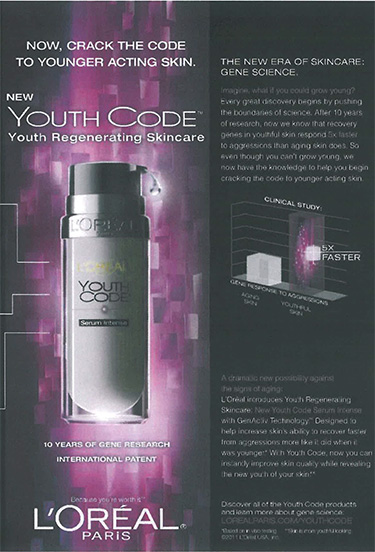
Cosmetics company L’Oréal USA Inc. has agreed to settle Federal Trade Commission charges of deceptive advertising about its Lancôme Génifique and L’Oréal Paris Youth Code skincare products.
L’Oréal made false claims that its Génifique and Youth Code products provided anti-aging benefits by targeting users’ genes, according to an FTC’s lawsuit.
“It would be nice if cosmetics could alter our genes and turn back time,” said Jessica Rich, director of the FTC’s Bureau of Consumer Protection. “But L’Oréal couldn’t support these claims.”
In national advertising campaigns for print, radio, television, Internet, and social media outlets, L’Oréal claimed that its Génifique products were “clinically proven” to “boost genes’ activity and stimulate the production of youth proteins that would cause “visibly younger skin in just seven days,” and would provide results to specific percentages of users.
For its Youth Code products, L’Oréal claimed – in both English and Spanish advertisements – the “new era of skincare: gene science,” and that consumers could “crack the code to younger acting skin.”
Charging as much as $132 per container, L’Oréal has sold Génifique nationwide since February 2009 at Lancôme counters in department stores and at beauty specialty stores. The company has sold Youth Code, which costs up to $25 per container at major retail stores across the United States, since November 2010.
Under the proposed settlement, L’Oréal is prohibited from claiming that any Lancôme brand or L’Oréal Paris brand facial skincare product boosts the activity of genes to make skin look younger, or responds five times faster to stress, fatigue, and aging, unless the company has reliable scientific evidence of such claims.
The settlement also prohibits claims that certain Lancôme brand and L’Oréal Paris brand products affect genes unless the claims are supported by reliable scientific evidence. In addition, L’Oréal is prohibited from making claims about these products that misrepresent the results of any test or study.
The public can comment on the proposed agreement at this link through July 30. After the comment period is closed, the FTC will decide whether to make the proposed agreement final.



