Student debt is a major financial problem in the United States. Except for mortgages, student loans are the largest share of household debt, and the total continues to rise. At the end of the second quarter of 2026, outstanding student loan balances were more than $1.72 trillion, according to the Department of Education. That amounts to more than $40,000 per borrower across 42.6 million Americans.
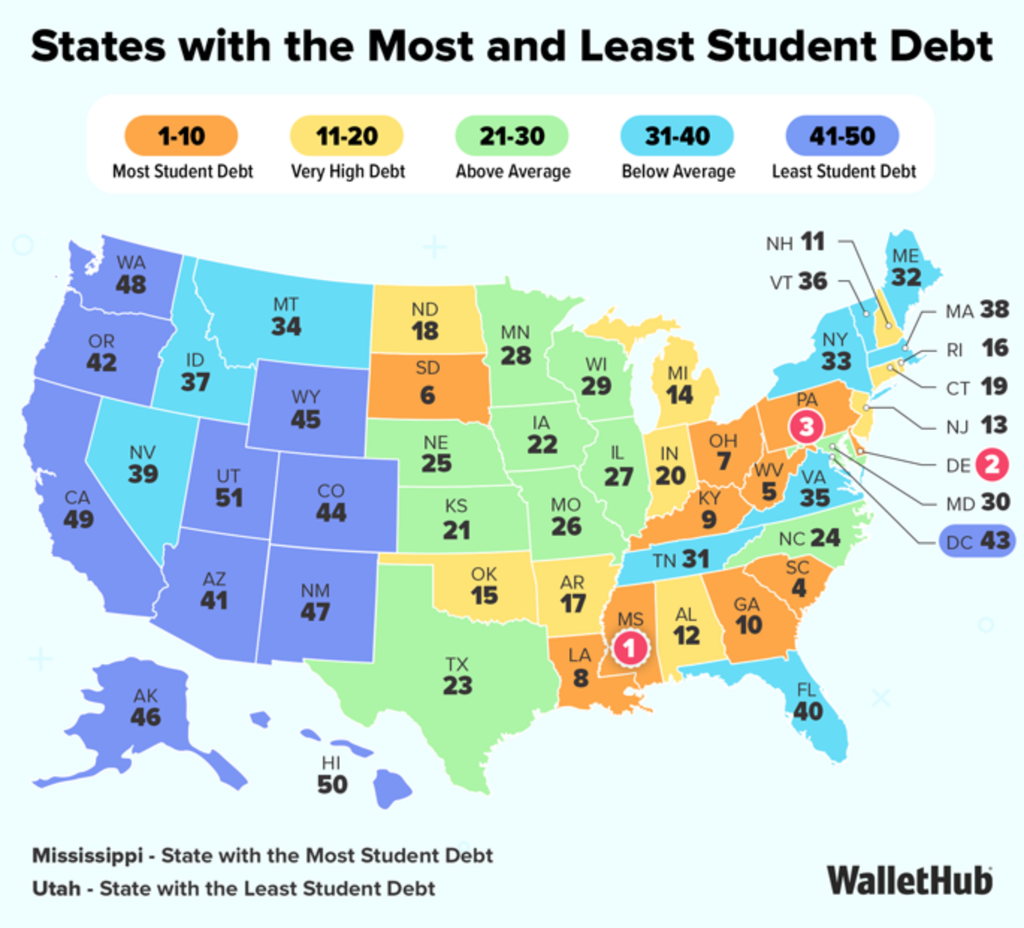
The amount of student debt varies from state to state. To identify where borrowers face the greatest challenges, WalletHub, a personal finance website, compared the 50 states and the District of Columbia across 12 measures of student-loan indebtedness and economic opportunity.
The data set includes factors such as average student debt, the unemployment rate among adults ages 25 to 34, and the share of borrowers with past-due loan balances.
States with the most student debt
- Mississippi
- Delaware
- Pennsylvania
- South Carolina
- West Virginia
States with the least student debt
47. New Mexico
48. Washington
49, California
50. Hawaii
51. Utah
“College keeps getting progressively more expensive, and so does borrowing money to attend,” Chip Lupo, WalletHub analyst, said in an email. “Federal student loan interest rates recently hit a 12-year high and remain elevated, making it important for borrowers to plan carefully when taking on student debt.”
Luop recommends, in addition to attending college in a less expensive state and pursuing other ways of funding such as financial aid and grants, students should also calculate how much they can afford to borrow before taking out a loan.
Mississippi has the biggest student debt problem in the country. The average amount owed by people with student loan debt is more than 54 percent of the median income in the state, the highest rate in the U.S.
In addition, Mississippi has the highest default rate on student debt, according to the WalletHub analysis. One reason why student borrowers are struggling in Mississippi is that they’re having a hard time finding jobs – the state has the third-worst availability of jobs to students, and the second-lowest share of paid internships.
“Parents, along with their children, should check out the colleges and universities that their children may want to apply to,” Daniel E. Goldberg, Ed.D., associate professor of instruction at Temple University, advises.
Goldberg recommends parents should sit with their children and do the research necessary to determine which schools have courses and resources that will help their children when it comes time for them to enter the job market.
“Figuring out the potential debt their children may be subjected to should be determined along with the potential benefits that each institution provides,” he said.