
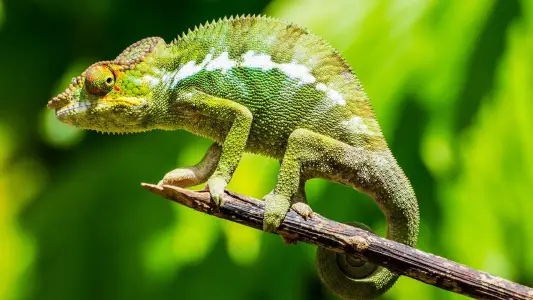
Today is International Chameleon Day. It’s celebrated every year on May 9 to bring worldwide attention to one of Madagascar’s most threatened group of animals.
“Chameleons are among the most extraordinary and evolutionarily unique animals on our planet, yet many species are disappearing before the world even has the chance to know they exist,” Debra Erickson, executive director of Wildlife Madagascar, an organization that works to protect Madagascar’s wildlife and conserve its lands and forests, said in an email.
Erickson said International Chameleon Day is about inspiring people to appreciate these remarkable reptiles and take action to protect the forests they call home.
Chameleons are unique because they have eyes that can move separately from each other. Each eye can look at something different. And they don’t really change color to match what they are sitting on, and they can’t change to any color or pattern. Instead, each chameleon species has certain patterns and colors that it can show on its skin.
There are more than 234 species of chameleons, and almost half of them live in Madagascar.
In many chameleons, their fully extended tongue is longer than their body, so they can catch prey that is some distance away.
Chameleons come in many sizes. The largest, Parson’s chameleon and Oustalet’s chameleon, can both be 2 feet long. The smallest, the nano chameleon, is about the size of a sunflower seed.
A recent update from the International Union for Conservation of Nature, or IUCN, Red List indicates that chameleons are experiencing a crisis that could lead to the extinction of many chameleon species.
Climate change threatens 184 of the world’s 200 chameleon species – or 92 percent of known species. Of these, nine species have been listed as critically endangered, 37 as endangered, and 20 as vulnerable, making a total of 66 threatened chameleons. If the near threatened category is taken into account – adding another 35 species – the percentage of chameleons in danger jumps to 55 percent.
For more information on chameleons, go to the Wildlife Madagascar website.
And check out this interview with Christopher Anderson, Ph.D., chair of the IUCN/SSC Chameleon Specialist Group, on why chameleons don’t get much research attention and why they’re so endangered.
In addition, consider making a donation to Wildlife Madagascar. It’s doing terrific work. It now has four field sites that focus on conservation efforts, research on native species, and community engagement to protect the unique biodiversity of Madagascar.
Many of Wildlife Madagascar’s recent accomplishments are summarized in “A Year in Review 2025,” an annual report.
Founded by my niece Debra Erickson, I’ve followed the work of Wildlife Madagascar since it began its work in 2023. I was the first member of Wildlife Madagascar.
I hope you’ll join me today in celebrate International Chameleon Day.
Photo: Wildlife Madagascar



